Research
The method
Hierarchical Bayesian statistics
Hierarchical Bayesian statistics is the thread that runs through my work. Galaxies reach us as noisy, incomplete measurements of populations that change with time: a hierarchical model infers the population itself, separating the intrinsic scatter of a relation from the errors of the data, and following how its slope, normalization and scatter evolve.
In my papers these models trace the stellar mass–velocity dispersion relation of early-type galaxies out to z ≈ 2.5, describe how the fraction of gas that galaxies accrete cold changes with redshift and halo mass in the HELLO and NIHAO simulations, and give the first characterization of how the link between galaxy disks and their dark matter halos has evolved since z = 2. Together with interpretable machine learning, they are how I bring simulations and observations together.
- 2020 · MNRAS 498, 1101The cosmic evolution of the stellar mass–velocity dispersion relation of early-type galaxies
- 2025 · MNRAS 537, 2726Gas accretion at high redshift: cold flows all the way
- 2026 · MNRAS 549Feedback-driven interactions between dark and luminous matter to explain tight galaxy scaling relations
01
How early-type galaxies are built
Every massive elliptical is a time capsule. Some of its stars formed in situ, from gas that flowed into the galaxy; others formed in other galaxies and arrived ex situ, through mergers. I want to know how much each channel contributed, and when: so I follow the cold gas that feeds massive galaxies at cosmic noon in the HELLO simulations, study what mergers do to the galaxies they build, and test simulations against what surveys such as MaNGA see today.
2023 · MNRAS 520, 5651 · First author
The contribution of in situ and ex situ star formation in early-type galaxies: MaNGA versus IllustrisTNG
We compare the stellar mass, age, metallicity and velocity dispersion profiles of massive early-type galaxies in the MaNGA survey with those of galaxies in the TNG100 simulation, where we can follow in situ and ex situ stars. The simulation reproduces most of the observed profiles, although its most massive central galaxies have velocity dispersions about 50 km s−1 higher than in MaNGA. Above about 1011 solar masses, the comparison points to a merger-driven evolution, with major mergers mixing the stellar populations of their progenitors.
Journal: The contribution of in situ and ex situ star formation in early-type galaxies: MaNGA versus IllustrisTNGarXiv: The contribution of in situ and ex situ star formation in early-type galaxies: MaNGA versus IllustrisTNGIn the list: The contribution of in situ and ex situ star formation in early-type galaxies: MaNGA versus IllustrisTNG
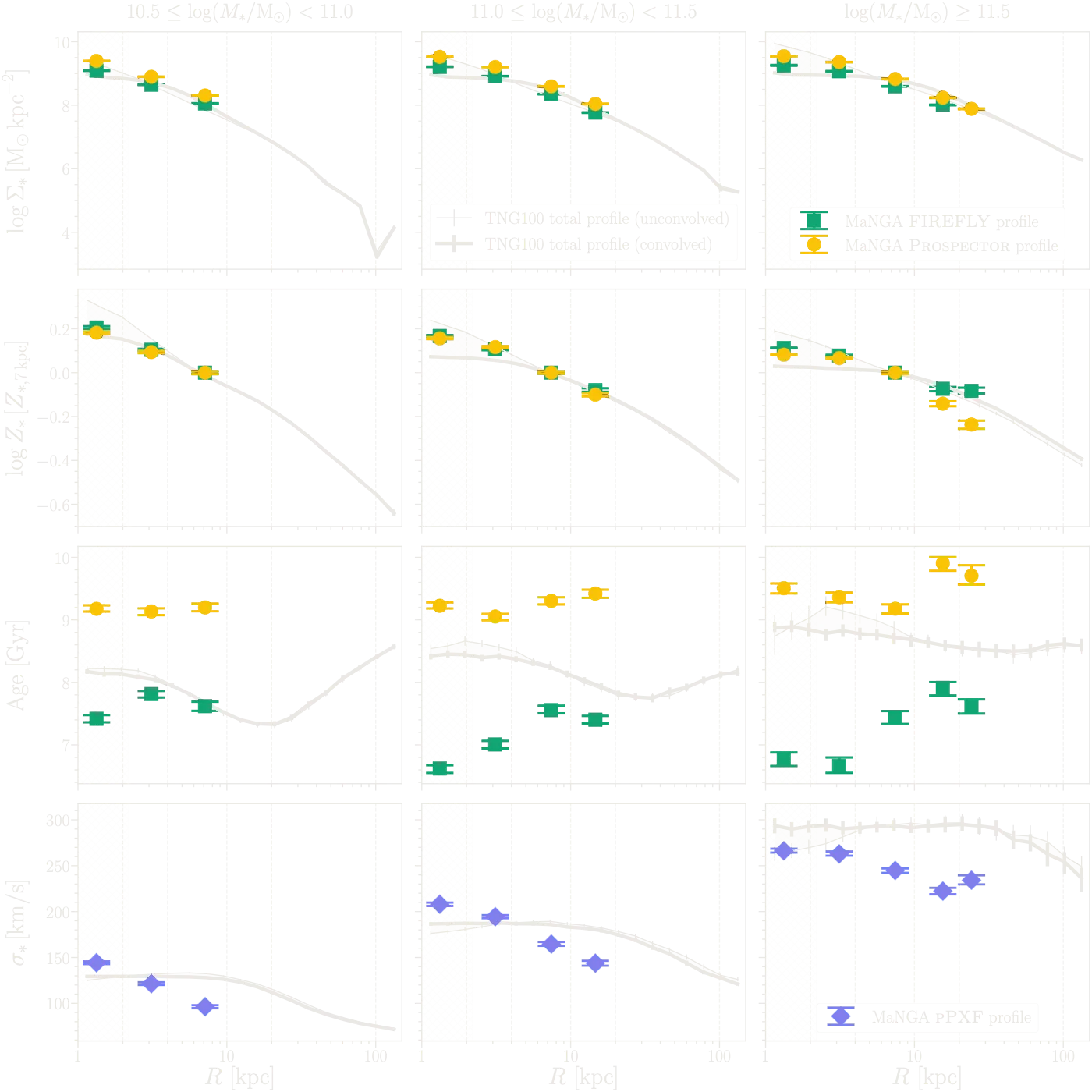
Figure from Cannarozzo et al. 2023, MNRAS 520, 5651 2025 · MNRAS 537, 2726 · Second author
Hierarchical Bayesian model
Gas accretion at high redshift: cold flows all the way
How do massive galaxies keep forming more than 100 solar masses of stars per year at z ≈ 2–4? In the HELLO and NIHAO simulations, cold filaments deliver more than 75% of the gas that forms stars, even in halos well above 1012 solar masses, and they fill so little volume that the hot outflows driven by star formation and AGN barely touch them. A hierarchical Bayesian model describes how the cold fraction of the accreted gas changes with redshift and halo mass.
Journal: Gas accretion at high redshift: cold flows all the wayarXiv: Gas accretion at high redshift: cold flows all the wayIn the list: Gas accretion at high redshift: cold flows all the way
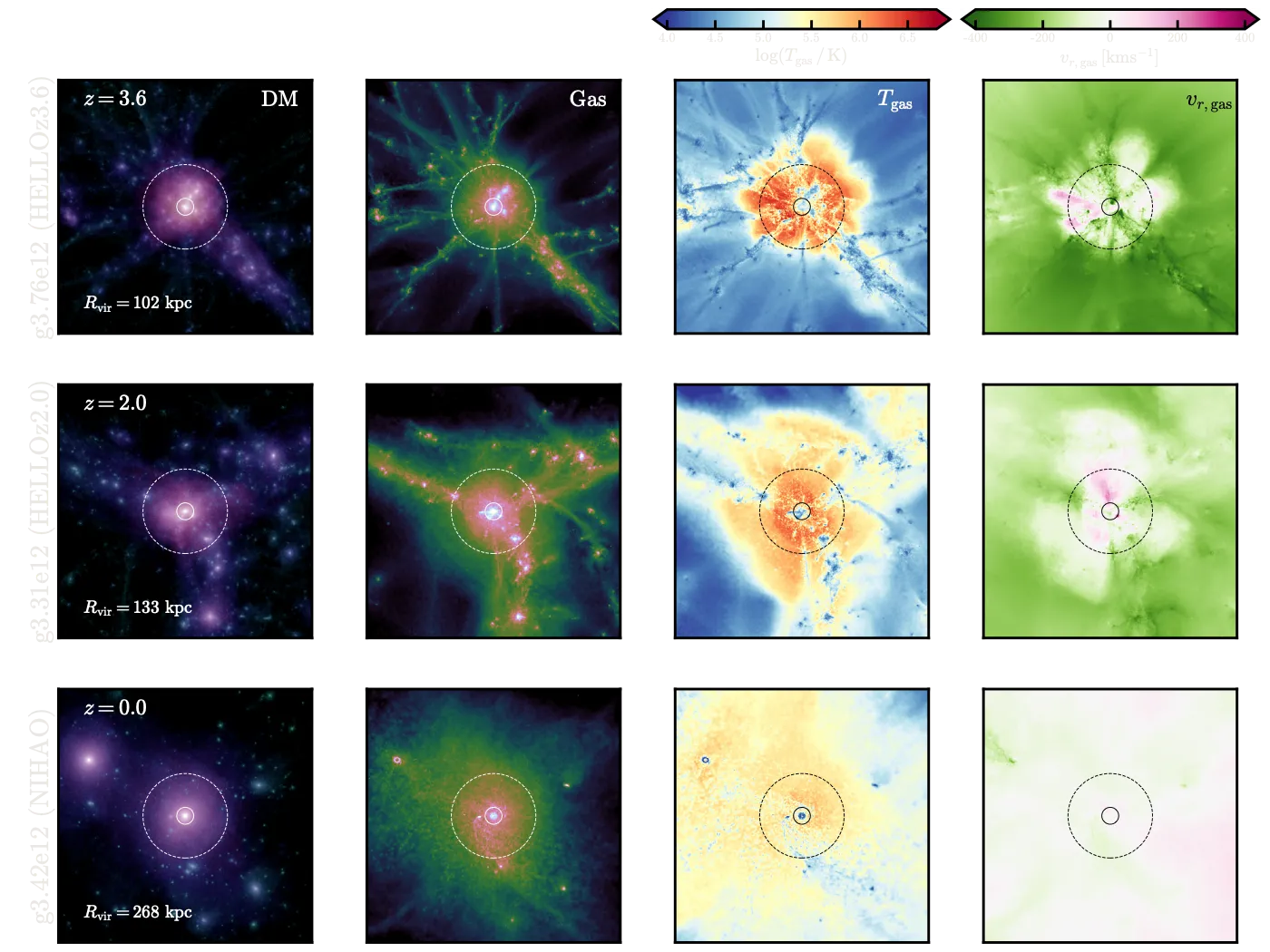
Figure from Waterval, Cannarozzo & Macciò 2025, MNRAS 537, 2726 2020 · MNRAS 499, 559 · Second author
Stellar velocity dispersion and initial mass function gradients in dissipationless galaxy mergers
In early-type galaxies the stellar initial mass function (IMF) appears “heavier” at higher velocity dispersion and toward the center. With simulations of major and minor dry mergers, we show that mergers flatten these IMF gradients and make the IMF within the effective radius lighter, while the velocity dispersion tends to decrease along cosmologically motivated merger histories. In a simple dry-merging model, galaxies of given velocity dispersion should therefore have heavier IMFs at higher redshift, unless the accreted satellites are very diffuse.
Journal: Stellar velocity dispersion and initial mass function gradients in dissipationless galaxy mergersarXiv: Stellar velocity dispersion and initial mass function gradients in dissipationless galaxy mergersIn the list: Stellar velocity dispersion and initial mass function gradients in dissipationless galaxy mergers
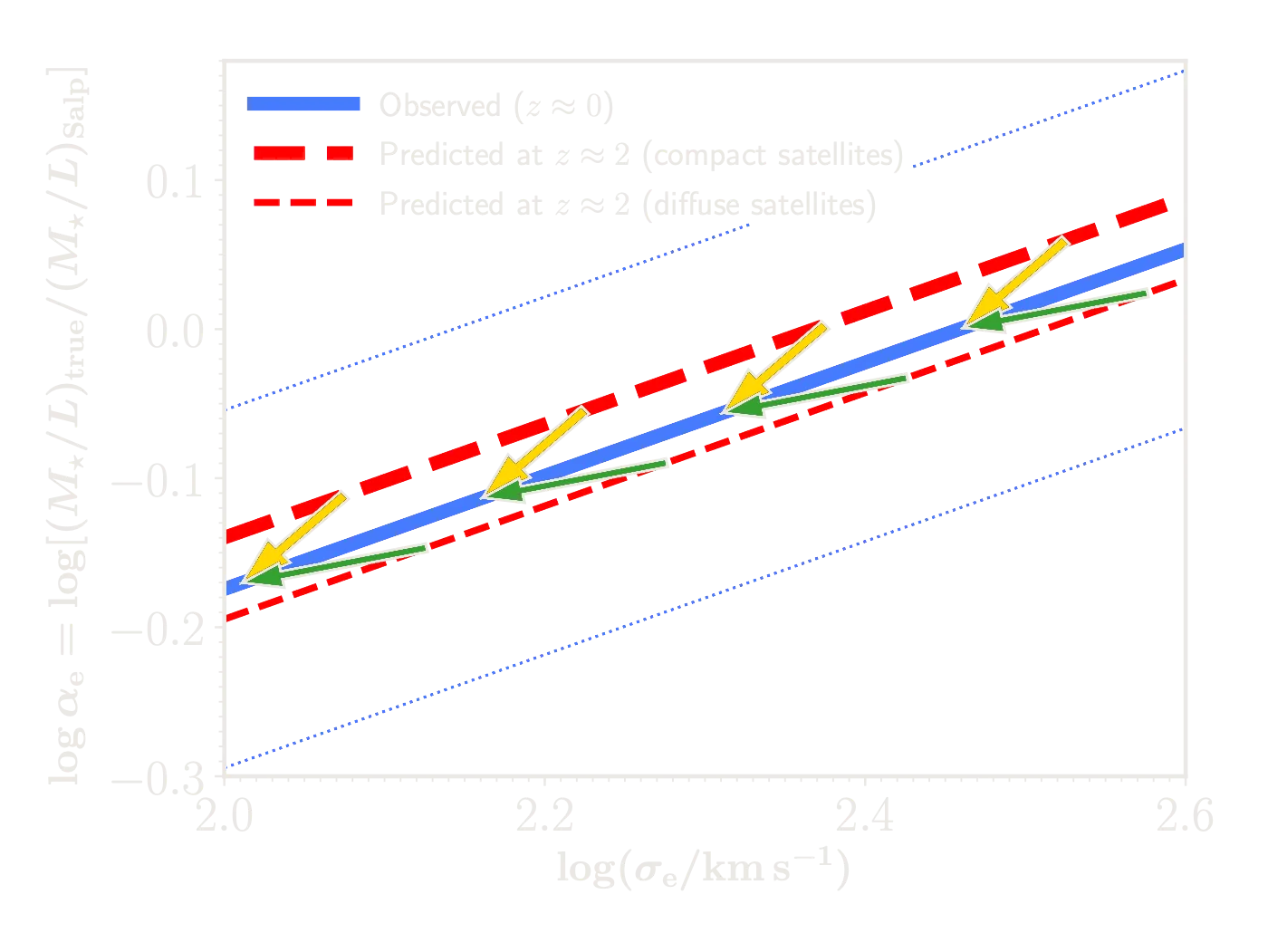
Figure from Nipoti et al. 2020, MNRAS 499, 559


02
What scaling relations remember
Scaling relations are the memory of galaxy formation. Their slope, their scatter and the way they shift with time all record how galaxies grew, from the stellar mass–velocity dispersion relation of early-type galaxies to the link between galaxy disks and their dark matter halos. I measure them with hierarchical Bayesian models, which separate the intrinsic scatter of a relation from the noise of the measurements, and compare them with simulations to find out which physics sets them.
2020 · MNRAS 498, 1101 · First author
Hierarchical Bayesian model
The cosmic evolution of the stellar mass–velocity dispersion relation of early-type galaxies
We trace the relation between the stellar mass M* and the central velocity dispersion σe of massive early-type galaxies out to z ≈ 2.5, with a hierarchical Bayesian model. Up to z ≈ 1, σe scales as M*0.18 (1 + z)0.4, with an intrinsic scatter of about 0.08 dex that does not change with redshift: at fixed stellar mass, σe falls by a factor of about 1.3 from z = 1 to today. The velocity dispersion of individual galaxies above about 3 × 10¹¹ solar masses decreases, on average, with time.
Journal: The cosmic evolution of the stellar mass–velocity dispersion relation of early-type galaxiesarXiv: The cosmic evolution of the stellar mass–velocity dispersion relation of early-type galaxiesIn the list: The cosmic evolution of the stellar mass–velocity dispersion relation of early-type galaxies
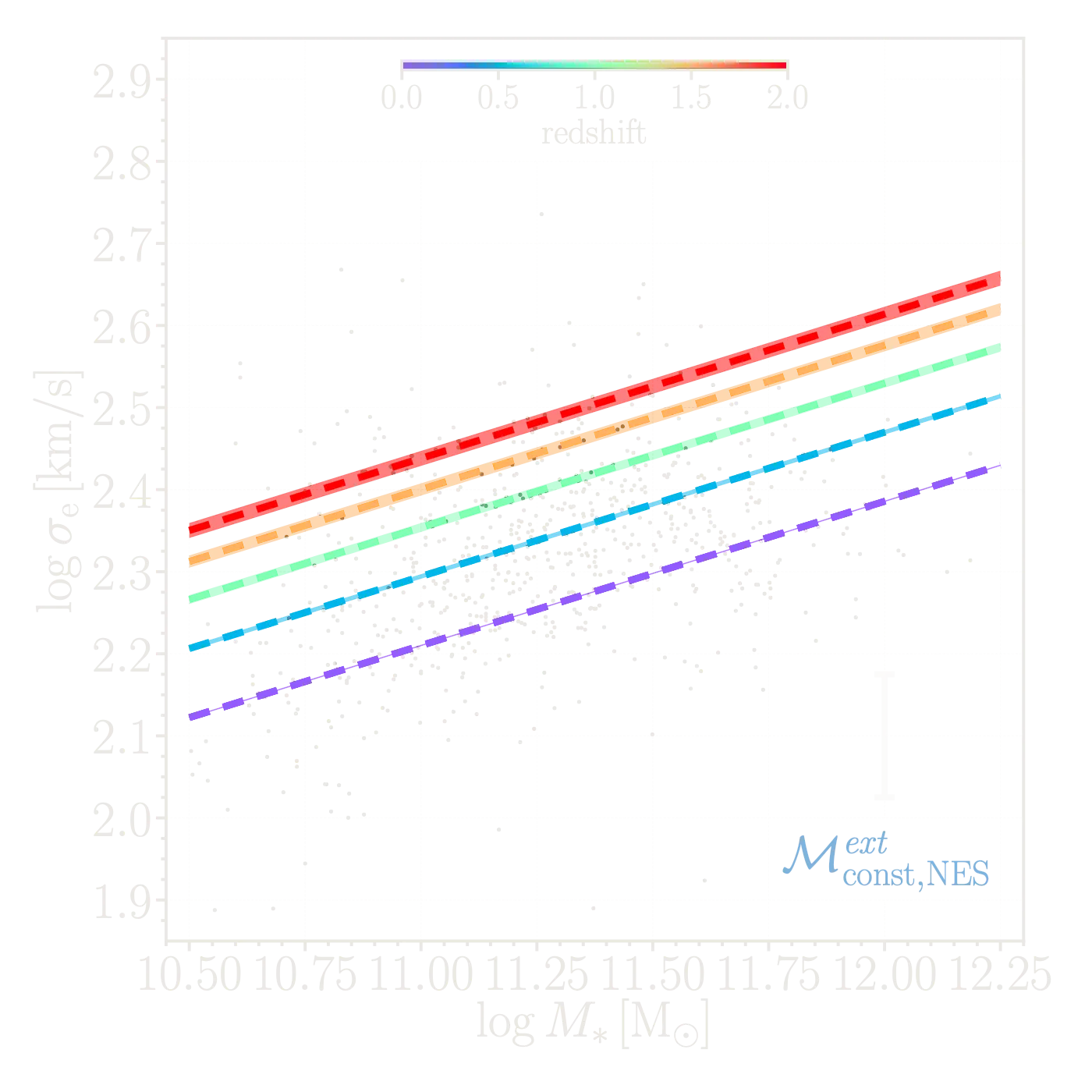
Figure from Cannarozzo, Sonnenfeld & Nipoti 2020, MNRAS 498, 1101 2026 · MNRAS 549 · Third author
Hierarchical Bayesian model
Feedback-driven interactions between dark and luminous matter to explain tight galaxy scaling relations
The size of a galaxy’s stellar disk correlates tightly with the scale radius of its dark matter halo, a link that has been read as a sign of interactions between baryons and dark matter beyond gravity. In 31 galaxies from the NIHAO simulations, where the two interact only through gravity, the relation comes out with the observed normalization and small scatter, and a hierarchical Bayesian model traces its evolution from z = 2 to today for the first time. Comparing with dark-matter-only runs shows that stellar feedback alone can reshape the central potential and build the coupling.
Journal: Feedback-driven interactions between dark and luminous matter to explain tight galaxy scaling relationsarXiv: Feedback-driven interactions between dark and luminous matter to explain tight galaxy scaling relationsIn the list: Feedback-driven interactions between dark and luminous matter to explain tight galaxy scaling relations
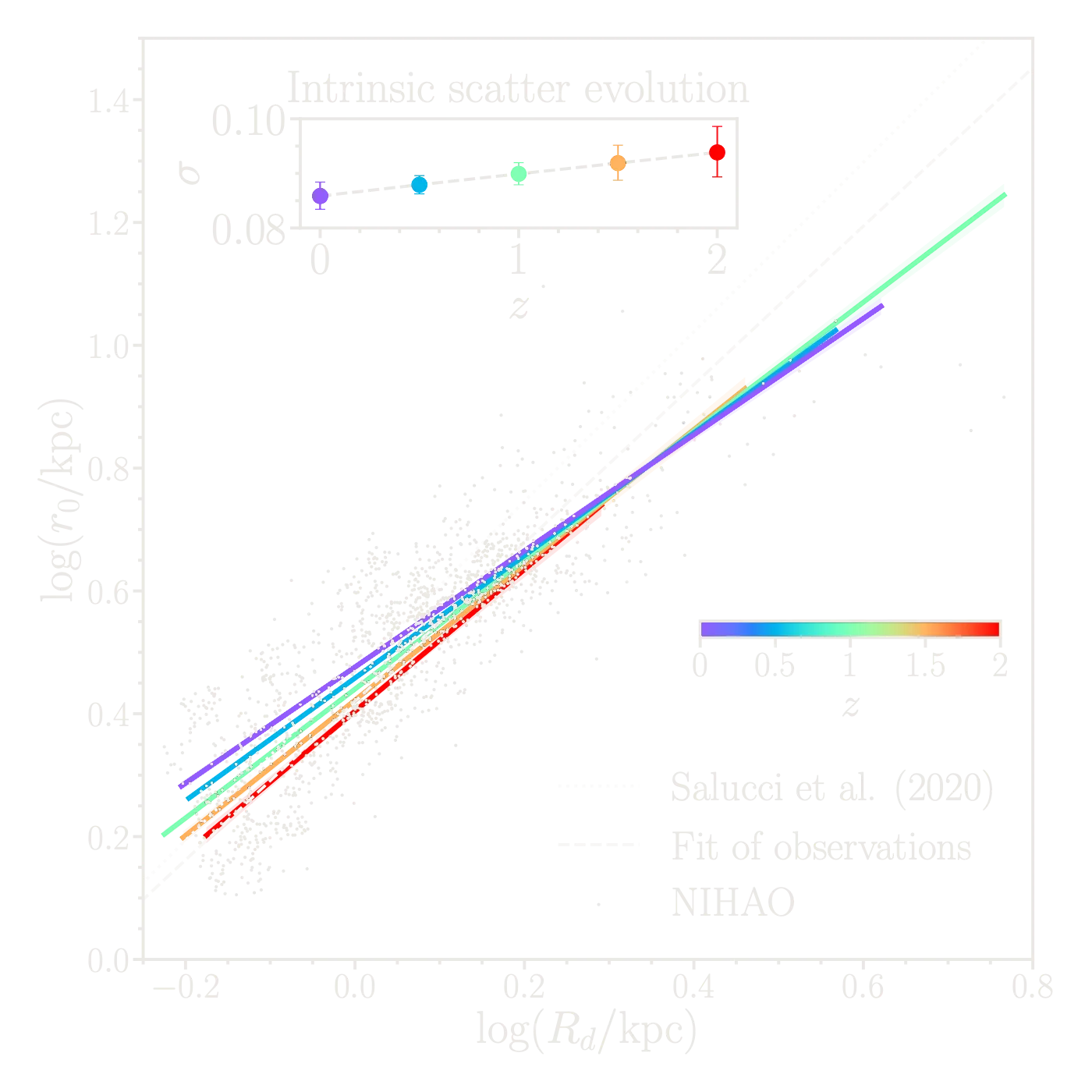
Figure from Alrawas, Macciò & Cannarozzo 2026, MNRAS 549 2024 · MNRAS 532, 4217
Non-monotonic relations of galaxy star formation, radius, and structure at fixed stellar mass
In about 29,000 nearby central galaxies, the star-forming main sequence bends at a stellar mass of about 2 × 10¹⁰ solar masses, which corresponds to halos of about 1011.8 solar masses, where virial shocks set in. At fixed stellar mass, galaxies that form more stars are smaller: their star formation rate scales with the effective radius as Re−0.28, as expected from the Kennicutt–Schmidt law, so sizes add to the scatter of the main sequence; above the bend this link weakens. The structure of galaxies above and below the sequence points to two ways of quenching low-mass galaxies: a fast one that changes their morphology while they are still on the main sequence, and a slow one that does not.
Journal: Non-monotonic relations of galaxy star formation, radius, and structure at fixed stellar massarXiv: Non-monotonic relations of galaxy star formation, radius, and structure at fixed stellar massIn the list: Non-monotonic relations of galaxy star formation, radius, and structure at fixed stellar mass


03
Galaxies and their dark matter halos
Every galaxy lives inside a dark matter halo, and the two grow up together. With my collaborators, I use that connection in both directions: halo assembly histories to reconstruct how galaxies grew, and the stars in the outskirts of massive galaxies to weigh and select their halos. The connection is also a test of ΛCDM itself: how massive can a galaxy be, given the halos the Universe has had time to build?
2025 · MNRAS 539, 913
On matching galaxy number densities to reconstruct galaxy evolutionary tracks
Matching cumulative number densities between redshifts is a standard way to trace galaxies back to their progenitors, but it assumes that those densities stay constant. We show that the assembly histories of dark matter halos make them evolve, so that progenitors at z ≈ 2 are 2–3 times less massive than this approach predicts, and ten times less massive by z ≈ 7. Evolving halo number densities give realistic tracks without model-based corrections, and the public code for these tracks is part of The ConCHa Project.
Journal: On matching galaxy number densities to reconstruct galaxy evolutionary tracksarXiv: On matching galaxy number densities to reconstruct galaxy evolutionary tracksIn the list: On matching galaxy number densities to reconstruct galaxy evolutionary tracks
2026 · Submitted to MNRAS
Empirical estimates of how massive galaxies can be in ΛCDM
How massive can a galaxy be? We apply extreme value statistics to the observed stellar mass and UV luminosity functions, accounting for measurement errors and for the scatter between stellar and halo mass: the most massive galaxy a survey can expect ranges from about 7 × 10¹² solar masses over the full sky at z ≈ 0 to about 1010 at z ≈ 16. With these effects included, the stellar masses of the most massive galaxies are compatible at every redshift with the baryon budget of their halos, 16% of the halo mass, and current observations remain broadly consistent with ΛCDM.
arXiv: Empirical estimates of how massive galaxies can be in ΛCDMIn the list: Empirical estimates of how massive galaxies can be in ΛCDM