Software
MARHABA
Coming soon...
Multi-scale Assembly Reconstruction of Halos And Baryons Across cosmic time.
My framework for the assembly histories of simulated galaxies. MARHABA post-processes the HELLO and NIHAO cosmological zoom-in simulations: it builds the merger trees of every halo, follows the selected galaxy’s dark matter, stars, gas and black holes through every output, and delivers standardized, versioned products with units, physical definitions and provenance, made to be shared with collaborators and, later, released publicly. Under internal development.
The name says hello, of course: مرحبا (marhaba) is Arabic for “hello,” a greeting from Abu Dhabi, where it is written, to NIHAO (你好, Chinese for “hello”) and HELLO, the simulations it is built for.
Work in progress
MARHABA is still under internal development: its definitions, products and interfaces may change before the first public release.
Today, MARHABA already:
- reads the Gasoline snapshots and the AHF halo catalogs itself, with the unit conventions of NIHAO and HELLO;
- writes particle data, a catalog of the whole suite and maps, in HDF5 (the catalog also in FITS);
- builds several merger trees of the whole simulation;
- tells the components apart (dark matter, stars, gas): it follows the chemistry of stars and gas, sorts the gas into ISM, CGM and IGM by its density and its distance from the center, and into phases by temperature, and separates the stars by their dynamics;
- measures the galaxy at every output: sizes, rotation, shape, star formation, the abundance of every element the run follows, and its baryon cycle, from cold and hot accretion to outflows and stripping;
- and much, much more.
Here is a first taste of what it delivers, on one galaxy: the main galaxy of g2.29e12, a HELLO cosmological zoom-in simulation, followed through 257 outputs, from redshift 15 down to 1.75, one output every 13.5 million years.
The director's cut
Watch it assemble
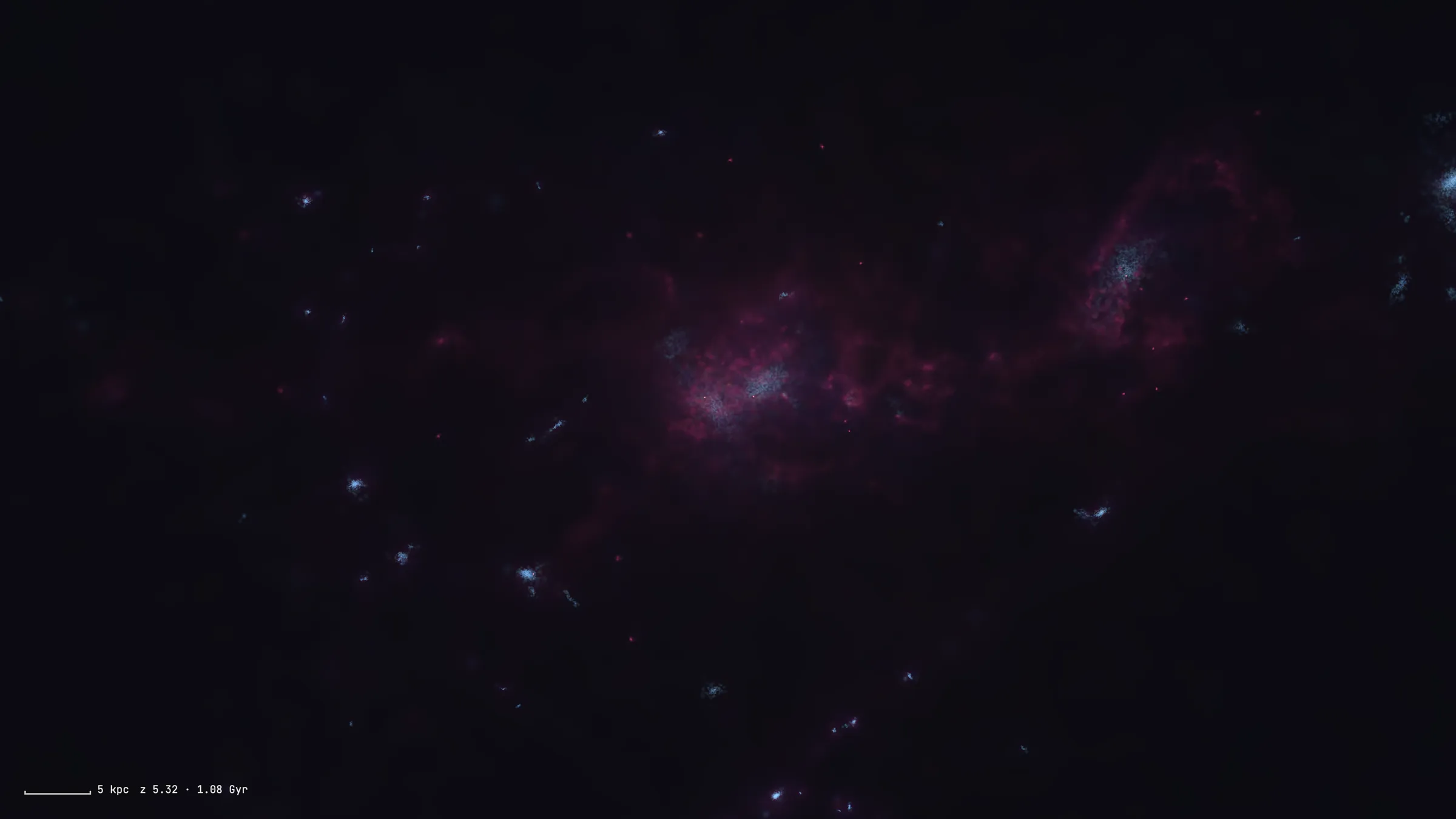
Dark matter, gas, stars and black holes, from the first filaments of the cosmic web to a barred disk. Every output is real simulation data, sampled particle by particle; the motion between outputs is interpolated. Color the gas by temperature or chemistry, the stars by age, and play the history at any speed.
Needs WebGL2. Best on a desktop with a fast connection: each output is about 3 MB.
Every merger, mapped
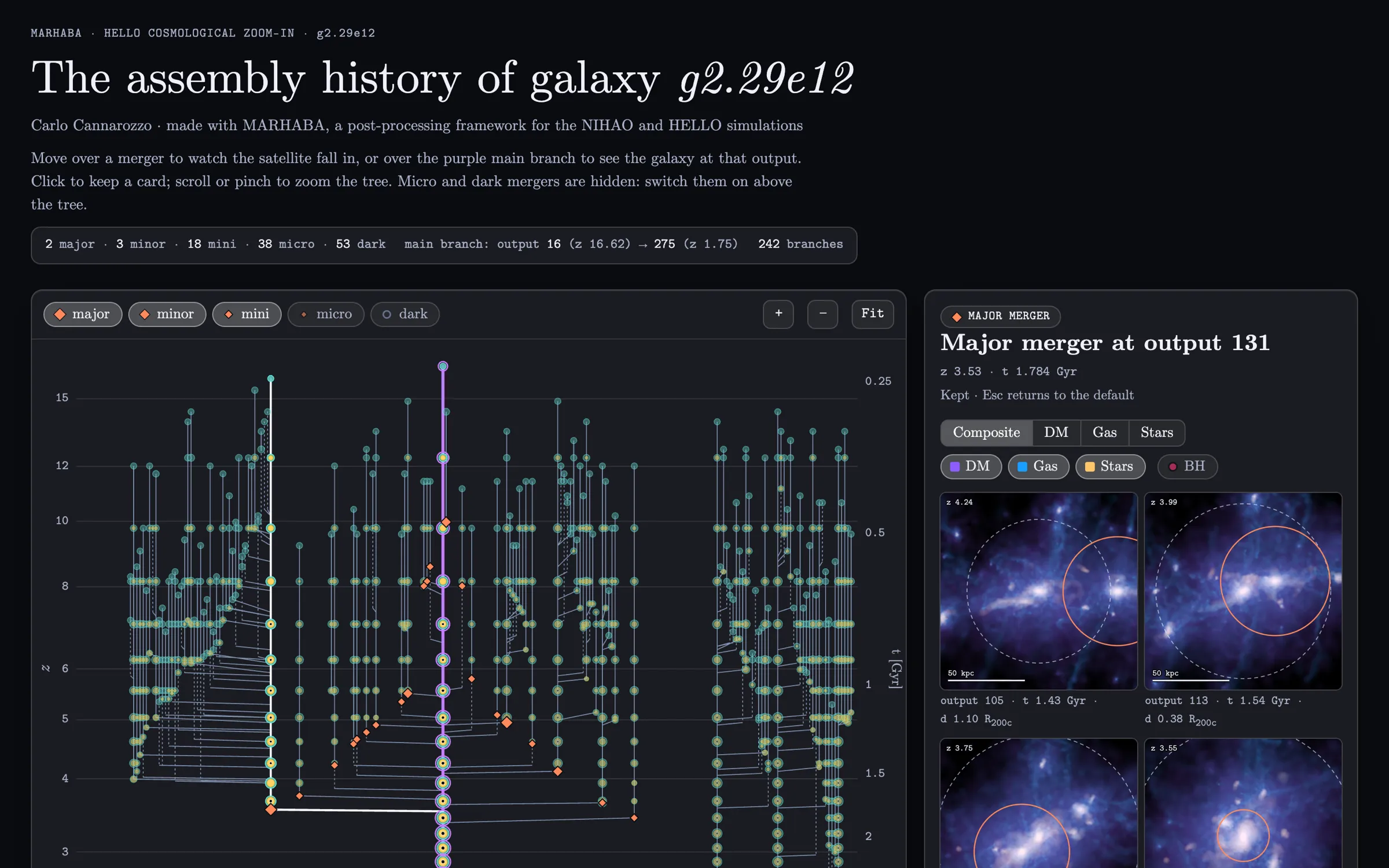
MARHABA follows the galaxy and every satellite by the particles bound to them, and draws each merger onto the main galaxy since redshift 17, from the smallest to the majors, with maps of the satellite falling in.
Simulation data: the HELLO project.